

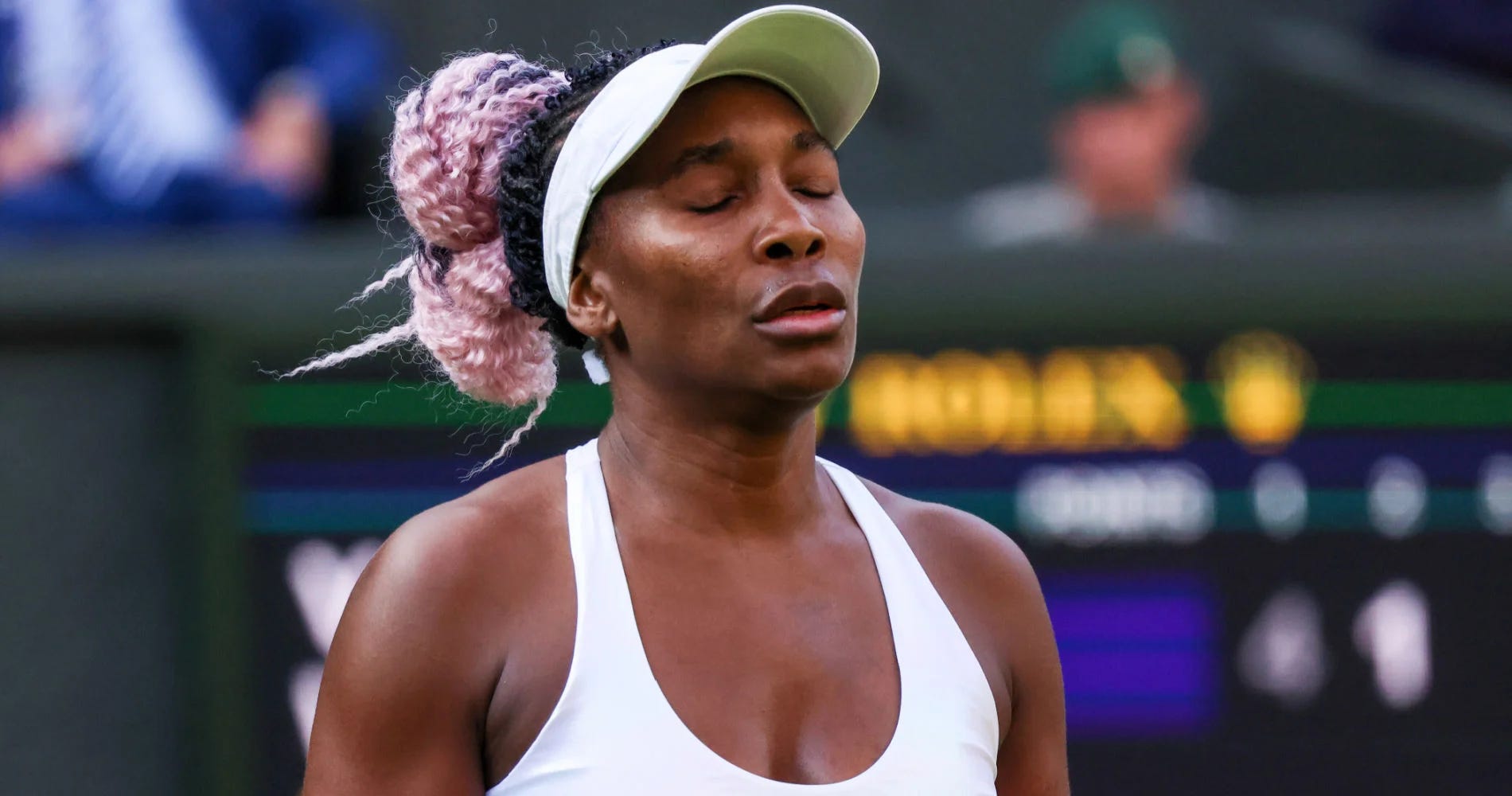
VENUS WILLIAMS, seven-time Major winner, undisputed tennis legend and inspiration to generations of tennis fans and players, is 46 years old. She is currently ranked 615 in the world, and hasn’t finished a year inside the top 300 since 2020. Last Friday at the Cincinnati Open, she lost 6-2, 6-2 in the first round to world no. 95 Emiliana Arango of Colombia, putting her record for 2026 at 0-11. She has lost 14 consecutive matches, and over her last 20 is 1-19. Her last victory came over Peyton Stearns in July 2025 in the first round at Washington. During her losing streak, she has played 31 total sets and won four.
Williams hasn’t qualified for a main draw entry in more than five years, since Wimbledon 2021 when she was ranked 70th in the world, but has since applied for and received 28 consecutive wild-card entries — essentially a special entry each tournament is allowed to grant at its discretion — and the result has been a 4-28 record with 24 first-round losses. By allowing her to skip the line seemingly indefinitely without much evidence in the won-loss column that she is still a competitive player, tennis fans publicly and tennis officials privately question whether Williams and the tournaments are violating the spirit of the wild card, unnecessarily pandering to a legend at the expense of less-decorated players, or if Williams has earned the right to continued entry to tournaments without having to qualify as recognition of her iconic career and its multitude of contributions.
Venus Williams is 46 years old, ranked 615th. She is 0-11 in 2026, has lost 14 consecutive matches, and is 1-19 over her last 20. She has won four of her last 31 sets. Since 2021, she has been granted 28 consecutive wild card entries. She’s lost in the first round 24 times.
The issue is not that she quit the tour– tennis is an individual sport and Williams can play as long as she chooses and can continue to play doubles – but that she’s been allowed to skip the line for five years and counting. Stan Wawrinka, three-time major winner himself, went down to the challenger level to compete and earn ranking points last year after being denied wild cards to the Wimbledon, US Open and Roland-Garros – the latter two major tournaments he’s won. Wawrinka improved his results and was granted a wild card to Roland-Garros, this year, the final appearance of his career. It is unclear if Williams would accept the challenge of having to win matches at the lowest levels of the sport and grind her way back into contention by playing the WTA calendar, raising her ranking through winning matches like everybody else because she hasn’t needed to.
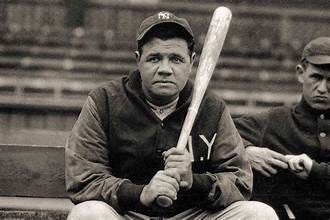
AN ATHLETE RETIRES BASICALLY by walking through one of three doors. Door No. 1 is when the game retires you: a player’s performance drops and they get dropped, or, in more sinister cases, the game decides a player is no longer worth the trouble. In the first case, 40-year-old Babe Ruth was hitting .153 for the 1935 Boston Braves. On May 25th in Pittsburgh, Ruth went 4-for-4 with three home runs and boosted his average to .206. His final hit of that game was career home run no. 714, a seventh-inning solo shot to right off Guy Bush. It was the last home run of Ruth’s storied career and also his final hit. Five days later, hitting 35 pounds under his weight at .181, the Braves released him.
In the second example, 43-year-old Barry Bonds hit .276 with 28 homers and 66 RBI for the 2007 San Francisco Giants. Bonds led the National League in walks with 132 (against 54 strikeouts), on-base percentage at .480, and intentional walks with 43. He certainly could have still helped a team, but nobody signed the irascible Bonds for 2008. They’d all had enough.
Door No. 2 is when your body retires you – Joe Montana concussed into quitting. Michael Irvin leaving the field for the last time on a stretcher. Larry Bird’s back hurting so bad he laid on the floor instead of sitting on the bench during games. In the summer of 2016, hitting well over .300 – he would wind up leading the American League in doubles with 48, RBI with 127, slugging and OPS and finish the season hitting .315 –David Ortiz explained why he was quitting when he was still an impact player.
“Because my fucking feet hurt,” he said. “Preparing for the game is worse than playing the game.”
Door No. 3 – going out on top – is the one all athletes crave but few ever enjoy. John Elway won consecutive Super Bowls and walked away. Jim Brown and Barry Sanders eluded Doors 1 and 2 the way they avoided tacklers. On Sept. 28, 1960, in the eighth inning, 42-year-old Ted Williams lyrically homered at Fenway Park off Baltimore’s Jack Fisher. He finshed the season hitting .316 with 29 homers and 72 RBI. The homer was his last major-league swing – and that was that.
Venus is in no danger of a Bonds-like banishment because no team can release her, but she owns a 1-11 versus players outside the Top 80 since 2021. Door No. 1 is an unrelenting stalker and no one is immune.
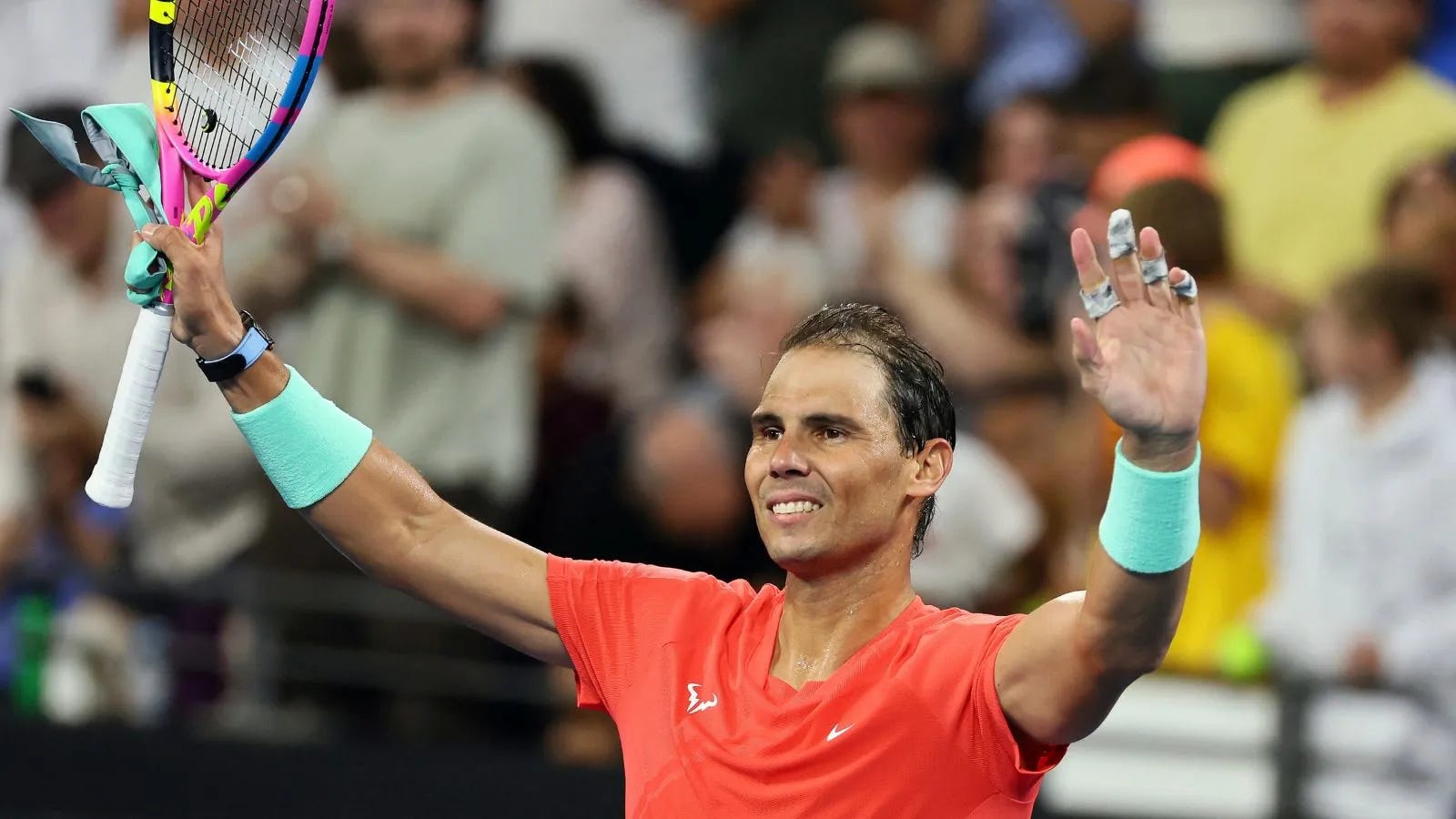
When it was time to go, even the great Nadal had to learn the hard way…
JOHN MCENROE ONCE SAID it was time to quit when he realized he was getting knocked around by guys who had no business beating him. The great Rafael Nadal could have poetically walked away from the game after beating Casper Ruud in the 2022 Roland-Garros final for his 14th French Open title, or a month later, gallantly and broken after beating Taylor Fritz in the Wimbledon quarterfinals and tearing his body to pieces so badly he couldn’t even play the semifinal against Nick Kyrgios two days later. Nadal couldn’t walk through Door No. 3. The only way to prove it was to go out and get mashed by guys who couldn’t touch him when he was beautiful. He needed to be battered into retirement — and he was.
So Rafa spent his final 18 months losing to guys he routinely tormented. Mackie McDonald. Alex De Minaur. Cam Norrie. Nuno Borges. Frances Tiafoe. Tommy Paul. Nadal even lost in the first round at Roland Garros in 2024 to Sascha Zverev without winning a set, finishing his career record at Roland-Garros an obscene 112-4. Door No. 1 had beckoned, Nadal resisted, but could no longer argue. He harshly received his proof and finally died on court with his boots on.
Williams needs no such evidence - she’s been getting crushed for years. She hasn’t beaten a Top 20 player in three years: Veronika Kudermetova, Cincinnati, 2023) or a Top 10 player since before COVID. (fifth-ranked Kiki Bertens, Cincinnati, 2019) Williams has been called selfish for applying for wild cards that would help younger players, but that isn’t exactly her decision – she’s can apply but no tournament is obligated to grant her a wild card. That responsibility falls on the tournament, but with the rise of the money at majors and the soaring expenses of just being a lower-ranked player, a wild card is very valuable to a young player who hasn’t earned multimillions on tour as Williams has. Wild cards to Washington, a 500-level tournament and Toronto, a WTA 1000, netted between $17,000 and $19,000 for a first-round exit, respectively. By contrast, a US Open first round slot pays $110,000.
Nor – especially at majors – is Williams still an undeniable box-office draw, for most of the tickets at the four big tournaments have been pre-sold for months. Smaller tournaments may benefit from the nostalgia of her presence – as well as offer fans a chance to see her perhaps for the first (or the last) time.
The rationale enabling Venus is one of respect but also one of recompense, of repairing the past. What is occurring is this: from a tournament’s perspective, Williams is a low-risk and harmless goodwill gesture – respect for who she is and what she’s been: an undisputed legend both on court and in historical impact on the game, and a feelgood inspiration that a player in her mid-40s is even out there at all. There is also little downside to goodwill gestures provided they are neither cynical – fear of backlash is not goodwill but cowardice – nor patronizing. Given the difficult history of how this sport has often treated Williams and her family over the past three decades, her presence represents a late, unspoken apology. More darkly, it is just not worth the hassle of denying her a wild card: the online trolling, the accusations of another chapter of unfairness toward the sisters, the racial sparring facing the tournament that finally says no to her, however justified, that inevitably will follow as this country in both small and seismic ways continues to tear itself to shreds. Better to just say yes.
Nevertheless, it is not last call for Venus Williams as a singles player – it is past call. Williams turned pro as a 14-year-old in 1994 and is half of a tennis dynasty that rewrote history. She has been a pro longer than most of her opponents have been alive. She has been standing in front of Door No. 1 for years and refuses to walk through, but tennis apparently isn’t quite ready to see her go, either — neither party quite yet willing to rip off the band-aid after all these years together. As the great philosopher Satchel Paige once said of life, which can be applied doubly to sports, where the young become quickly and unforgivingly old, “You only come ‘round this way once.”
I am torn on whether tournaments should continue to offer Venus wild card entries. I fully get the arguments in favor of doing so, which you articulate well. My concern is that so few players -- including men and women who are in the top 200 in the world at what they do -- are even meeting their expenses, let alone earning a lucrative living, as this recent article discusses. https://tenngrand.com/fewer-than-six-hundred-tennis-players-earn-more-than-they-spend/ It would be easier on everyone if Venus followed Stan Wawrinka's lead and played some Challenger matches. In fact, Wawrinka just declined a wild card at the Cincinnati Masters 1000 event and instead is playing at a 125 Challenger in Cancun.
Venus is leaving a legacy that preserves her values, memories & lessons for people that matter. plus she’s leaving something in people, & part of a bigger narrative.