What Am I Doing Here?
No, really. What?

Fourteen years ago, nestled in a press seat at Suzanne-Lenglen on a gray day at the 2012 edition of Roland Garros, Rafael Nadal administered one of the most merciless beatings I’ve ever witnessed, so bad that those Parisian ambulances that encircle the 16th Arrondissement, whose singsong siren cadence provides the clearest indicator you are in Europe, might have been summoned to the grounds in emergency response.
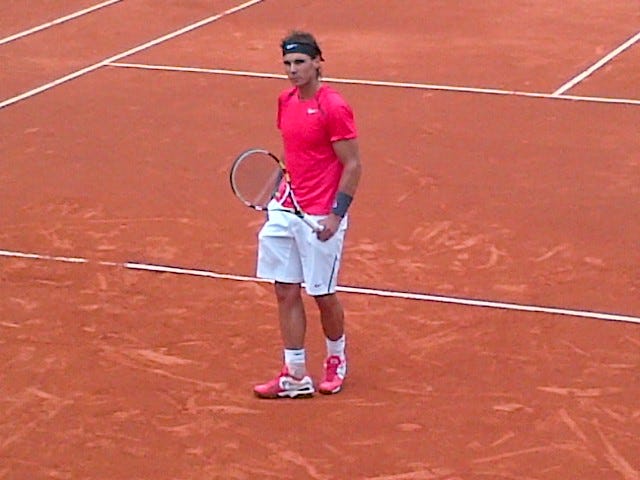
(First-person photographic evidence of crime scene and perpetrator. June 4, 2012. Victim not shown.)
The final score over his very good friend Juan Monaco was a gorgeous and savage 6-2, 6-0, 6-0, gorgeous because there was beauty in watching a player in complete command of their abilities, so much to the point where Nadal, at the time ranked second in the world behind Novak Djokovic, made the 13th-ranked Argentine look like a club player. Monaco held for 2-1 in the first set — and then lost 17 games in a row.
Yet, it was also clear that Monaco’s level was probably good enough to beat all but a handful of his world-class peers. Nadal was simply that good, and he followed up his performance on Lenglen by inevitably marching to the title, handling fellow Spaniard Nicolas Almagro 7-6(4), 6-2, 6-3, then destroying another compatriot, sixth-seeded David Ferrer 6-2, 6-2, 6-1, before hoisting the trophy following a cathartic 6-4, 6-3, 2-6, 7-5 win over Djokovic amid the mud puddles of a rare Monday Final.
There’s no real reason for this anecdote beyond it being a reminder of what’s been missing — the need to write regularly. Whenever I’ve had an opinion worth exploring, there’d always been a mandatory, daily landing space — the Boston Herald from 2002 to 2005, ESPN.com for the last 18 years, the back page column of ESPN the Magazine for many of them. The longer and alternate forms remain: despite the industry gloom and lament readers only want political memoirs and romantasy, publishing houses have been putting my book ideas into the world since 2002. Since 2006, NPR’s Weekend Edition with Scott Simon has been an anchor every other Saturday, and while it has been a joy now working in the unscripted documentary space, there is nothing like expanding a thought, connecting dots, saying something. Too many ideas recently have gone nowhere beyond a meaningless Threads post. There’s more to life than 240-character fragments.
I haven’t been a hermit. The New York Times Guest Essay has been welcoming but infrequent, as has The Guardian, but after leaving ESPN last year, the daily writing space that once would have guaranteed a meditation on the Djokovic-Fonseca epic, the bland inevitability of Jannik Sinner (and then what happened?), the final bows of Stan Wawrinka and Gael Monfils or the poetic humanity of Coco Gauff, needed to be replaced. Tennis only amplified the void.
To my shock and surprise, I’ve had a Substack page for years. I already subscribe to several writers — Joe Posnanski, Molly Knight, Heather Cox Richardson, Tommy Tomlinson, and Doug Glanville, to name just a few, but mine had sat not only dormant, but never used. There were reasons.
Ours is a troubled world. Journalism is one of many distressed fields. People often use benign language out of sheer laziness, but even more often, especially now, that vague passiveness is used to mask something far more frightening: the crumbling of our institutions. Businesses merely refer to massive layoffs as “pivots.” When I worked in newspapers, from the Oakland Tribune to the San Jose Mercury News, The Bergen Record, Boston Herald, and The Washington Post, the dissolution of the traditional foundations in media — the rising cost of newsprint, the dramatic erosion of classified advertising, and loss of lucrative full-page ads coinciding with the demise of big-box department stores — were not called harbingers. They were called a “shift.”
The language was not the byproduct of laziness, after all. It was a byproduct of fear — and none of it was benign.
None of which is to say that institutions don’t need to improve and that things don’t change and some changes are for the better, and my conflicts with the elements of our socioeconomics that were reflected in my dormant Substack page were just that, conflicts.
The dormancy reflecting my conflicts about where and who we are. Some were practical: my ESPN contract prohibited me from writing for outside outlets, and between that and book writing, I was generally out of words, evidenced by the death of Carpaccio, my dearly, departed food blog I wrote for fun when I was traveling the country. The last entry was April 9, 2018. Ellis Burks and I were watching the NCAA tournament at Lo-Lo’s Chicken and Waffles in Scottsdale, Arizona during spring training and he told me about the time he hung out with Whitey Bulger.
Other conflicts were more serious. One person’s pivot is another person’s gig economy, and I was concerned about these mediums — Substack: friend, foe, or double agent? The word “disruption” from a technology company, is actually a tell, a supervillain’s origin story. If that sounds like hyperbole, remember how badly cabs used to suck — now try pricing out an Uber from LAX at 4 p.m.
I was conflicted with asking the public to pay for more, to a la carte their way through their paychecks. How many more streaming/subscription services are we going to expect the public to carry, especially from a Constitutionally protected field as the free press.
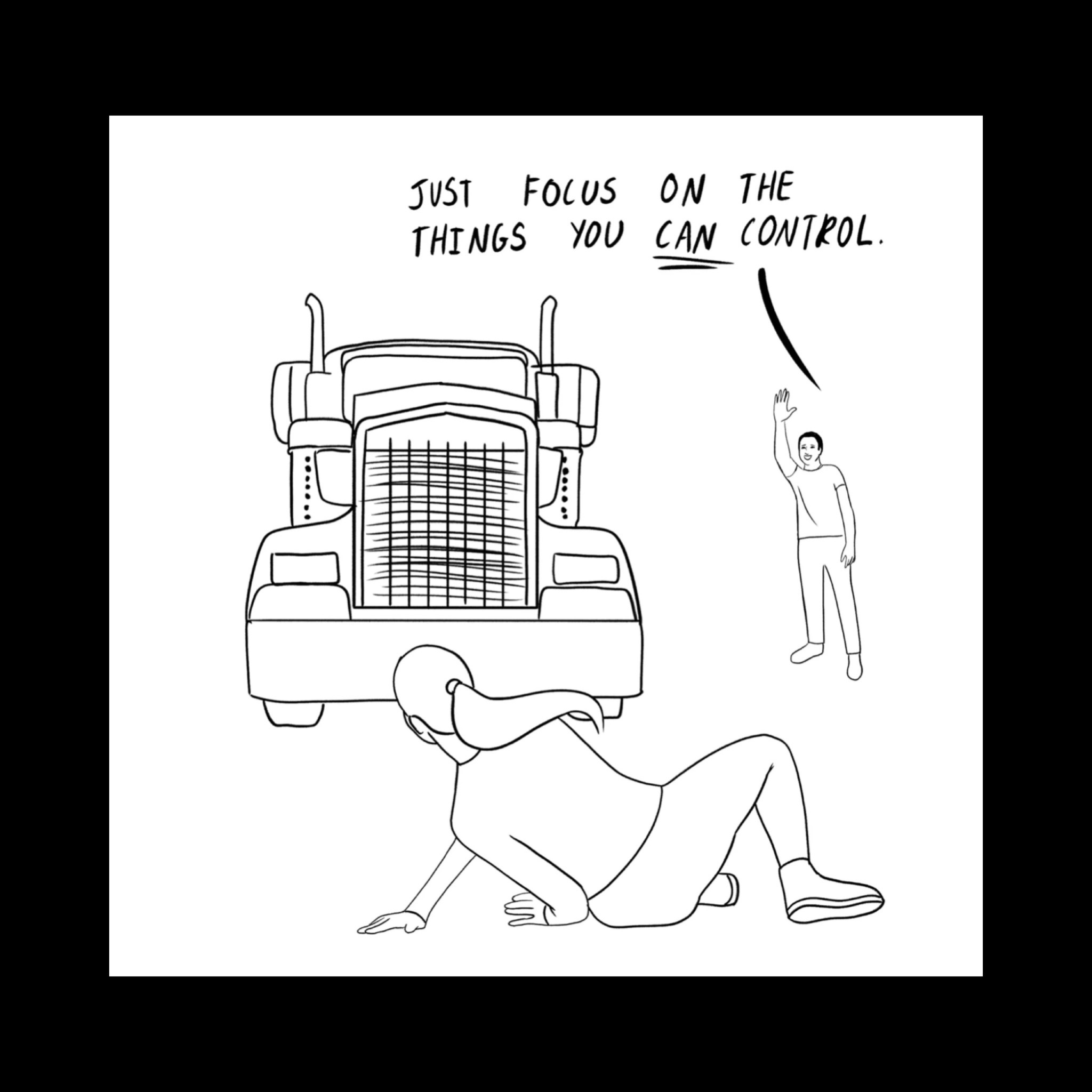
(Journalism 2026, in one image from The New Yorker)
My final conflict was the prospect of starting a new business, of buiding a following, of how this world gibed with my worldview — sneering at the incubating nihilism of journalist as “brand,” even as it offers the potential for autonomy, and maybe, groceries. It is already true in publishing that authors must now not only write their books, but sell them more in greater, uncompensated measure, and so thus it is also true that journalists must do the work themselves, regaining the lost institutional trust, apply it to themselves individually, and hope an already depleted public will have its faith restored.
So what am I doing here? I’m doing what I do — writing, by concluding it was ultimately a cop-out to say nothing, or less, when we are surrounded by bad actors undermining the institutions and values I’ve written about for years, especially when so many media outlets have chosen collaboration, capitulation. Americans believe they are above catastrophe, convinced Krypton is merely shifting its orbit (if you know, you know), while rewriting its definitions of American exceptionalism into a dark tombstone whether the subject is January 6, or Pete Rose. For years, my back-page column at ESPN The Magazine was titled “The Truth,” and maybe that title should resume here, considering we’re being told we’re witnessing the death of it.
“The Truth, Continued…” perhaps.
My ninth book was titled Full Dissidence: Notes from an Uneven Playing Field and the field is even more tilted, the issues more urgent. We are in hostile territory, and it’s not merely a “pivot.”
In between the seriousness and the sports, you will see another section on this page titled, “Intermezzo,” which is fancy-sounding Italian for “intermission,” and who doesn’t need levity? Here, that intermisison will be a detour from race and sports into thoughts and musings on cinema. Why “Intermezzo” and not “Interlude” or some other English word? Because I was watching Vittorio De Sica’s Marriage Italian Style (1964) and his classic Bicycle Thieves (1948) on back-to-back days when I thought of it. Seemed like a good idea, added a little class to the joint. Maybe Carpaccio needs to make a comeback, too. After a long day, who doesn’t need an post-movie affogato in their lives?
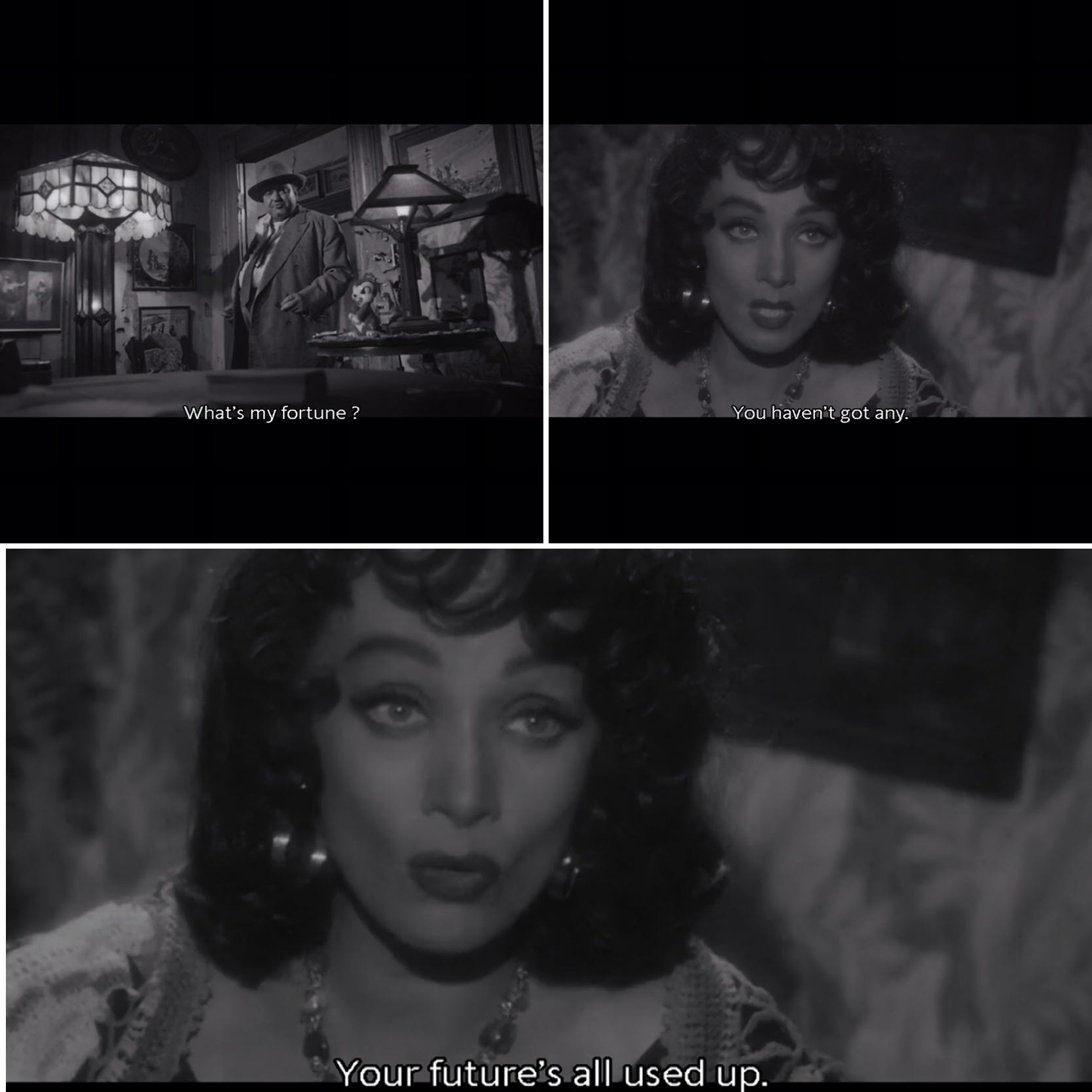
(To leave on a positive note, Hank Quinlan’s destiny does not have to be ours.)
So that’s it. Motivated by the concurrent urges to pen a farewell tribute to Monfils and reflect on Nadal’s 112-4, 14-0 in Finals CV at Roland Garros, I am back to saying things regularly — at my speed and my pace — and saying them here. A new home. I hope you’ll join and support, engage in the comments and discussions, chats and zooms, as well as the other events to come, and, if nothing else, agree that flopping is immoral, salary caps do not create parity, and avoid the urge to ask if Die Hard is a Christmas movie.
Glad to have your writing back in my life!
So glad you are here and doing this, my friend. We need your voice.